Does money actually motivate?
Most managers assume the easiest way to raise employee motivation is to raise pay. Yet plenty of people earning perfectly decent salaries still feel tired, dissatisfied, or minded to leave. That tells us the relationship between money and motivation is not linear. To understand it, we lean on Self-Determination Theory and on Herzberg's two-factor theory.
Controlled and autonomous motivation: two sides of the same process
Self-Determination Theory distinguishes two kinds of motivation that differ in quality, in what drives them, and in their consequences.
Controlled motivation appears when we act because of pressure, rewards, punishments, other people's expectations, or a fear of losing something. It might be the pull of a bonus, a promotion, or avoiding criticism. It is not “bad”, and it can produce high performance - but mostly in the short term. Because it depends on external factors, managers have to keep renewing it. When the reward stops or the pressure eases, the motivation falls away with it.
Autonomous motivation appears when a person acts because they want to: because the activity is interesting, meaningful, or part of who they are. That kind of motivation lasts longer, is more resilient under stress, and leads to greater creativity and commitment. It develops when three basic psychological needs are met: autonomy, competence and relatedness.
In practice the goal is not to eliminate or reduce controlled motivation, but to increase the share of autonomous motivation - because that is what produces durable, healthier, sustainable outcomes.
How long does a bonus last?
Bonuses and other material rewards are the most common way companies try to lift motivation. Contemporary research suggests the effect is largely short-lived. One key reason is hedonic adaptation: people acclimatise quickly to a new financial gain, and the initial lift in motivation returns to its baseline. The emotional effect typically lasts a few days, while the cognitive impression of having been rewarded can persist for a few weeks - but rarely beyond two months (Jeffrey & Adomdza, 2011; Stajkovic & Luthans, 2003).
Meta-analytic work in organisational psychology finds that improved performance holds for a relatively short period and then gradually fades (Cerasoli et al., 2014). Studies using real-time measurement across the working day confirm the motivational effect of a bonus declines after two to three weeks (Killingsworth, 2021). And where bonuses repeat year after year, employees come to experience them as the standard, which weakens the effect further (Rynes et al., 2004).
Research grounded in Self-Determination Theory explains why. Material rewards act primarily on controlled motivation - which, as above, depends on external expectations, pressure or rewards. It can be very strong, but it is not stable. Remove the external source and the motivation drops with it (Deci, Koestner & Ryan, 1999).
So bonuses can be useful as a short-term stimulus. They are not a sustainable way to develop intrinsic motivation in an organisation. For that you need a working environment that consistently supports a sense of choice, the development of competence, and genuine working relationships.
Does more pay really bring more happiness?
The three largest global data sources - the Gallup World Poll, the World Happiness Report and the General Social Survey - give a fairly clear picture of the relationship between income and satisfaction. Happiness and life satisfaction rise with income, but only up to a point. Beyond that, additional income has almost no effect on subjective wellbeing. The largest effect comes from escaping financial stress; once someone is in a stable middle income, the curve flattens out. Globally, saturation sits somewhere around USD 60,000 to 100,000 a year, depending on the country.
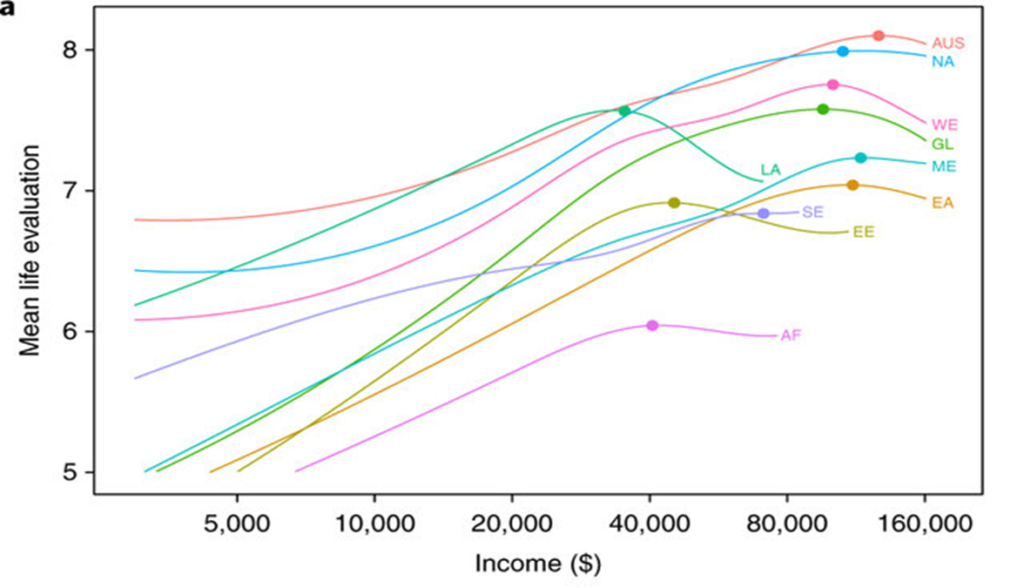
Source: Nature Human Behaviour - AF, Sub-Saharan Africa; AUS, Australia/New Zealand; EA, East Asia; EE, Eastern Europe/the Balkans; GL, global; LA, Latin America/the Caribbean; ME, Middle East/North Africa; NA, Northern America; SE, Southeast Asia; WE, Western Europe/Scandinavia.
What do studies of millionaires show?
Smeets, Whillans and Norton (2019) found that millionaires are somewhat more satisfied than average - but far less so than one would expect. The largest gain in happiness happens when people leave financial insecurity behind, not when they become wealthy. Among millionaires, the most common motives for working are not money but development, influence and meaning. Money becomes a hygiene factor rather than a motivator.
And in Serbia, and other lower-income regions?
Gallup World Poll and World Happiness Report data for Serbia show the influence of income on happiness is stronger in lower pay brackets - but there is a saturation point here too, once someone reaches a stable middle income. After that, motivation is determined far more by relationships at work, opportunities to develop, a sense of autonomy, and support from colleagues and managers.
Herzberg: why pay does not create motivation
Herzberg's theory distinguishes hygiene factors from motivational factors. Hygiene factors, pay among them, prevent dissatisfaction but do not by themselves raise intrinsic motivation over the long run.
Put plainly: when pay is low or inadequate, employees are dissatisfied and demotivated. When pay reaches an adequate level, the basic financial need is covered - but further increases do not automatically produce more motivation to work. Motivational factors such as recognition, challenging work and opportunities to advance are what drive long-term intrinsic motivation and job satisfaction.
Which is why managers should not rest motivation solely on salaries and bonuses, but also on the factors that create a sense of meaning and competence. The combination of adequate hygiene factors and genuine motivational factors gives the best results.
Why external rewards can undermine intrinsic motivation
The meta-analysis by Deci, Koestner and Ryan (1999) shows that external rewards can undermine intrinsic motivation when the person experiences the reward as imposing a behaviour on them. The more conditional the reward, the lower the intrinsic motivation.
A reward is conditional when a specific result or behaviour is required in order to receive it, rather than the person acting out of interest or curiosity. Telling an employee “finish this report by Friday and you get a bonus” makes the reward conditional and can reduce intrinsic motivation for the report itself. By contrast, when a bonus or recognition arrives as a spontaneous acknowledgement of effort, without strictly defined conditions, intrinsic motivation suffers far less.
The key is that the reward should not control the behaviour but recognise the effort and the achievement. Rewards of that kind can even support intrinsic motivation, because they confirm a sense of competence and acknowledge autonomous work.
Three needs, and how companies can nurture them
Autonomy, competence and relatedness are what drive autonomous motivation. Companies that understand this create better conditions for long-term outcomes.
Autonomy. Google is well known for its “20 per cent time”, Atlassian for “ShipIt” days where employees choose what they build, and 3M introduced free time for personal projects - which is where the Post-it note came from. All three show that a small amount of freedom produces a large increase in creativity and engagement. It is worth being precise, though: providing autonomy does not mean total freedom. It means the ability to make one's own choices within defined business boundaries and work tasks.
Competence. Pixar runs continuous creative workshops for learning and experimentation, and Microsoft reshaped its feedback culture to be oriented towards growth rather than evaluation.
Relatedness. Zappos cultivates team closeness through authentic rituals and open communication, while Patagonia builds community through shared social and environmental activity.
When those three needs are met, productivity, creativity and loyalty rise naturally and durably.
What managers can actually do
The first task is to provide fair, stable pay - but that is where it begins, not where it ends. An organisation that wants sustainable motivation has to focus on employees' psychological needs: more choice in how work is done, more opportunity to learn, and a healthy team culture.
Use material rewards carefully, and put most of your energy into developing autonomous motivation. It is what produces the longest-lasting and healthiest professional outcomes.